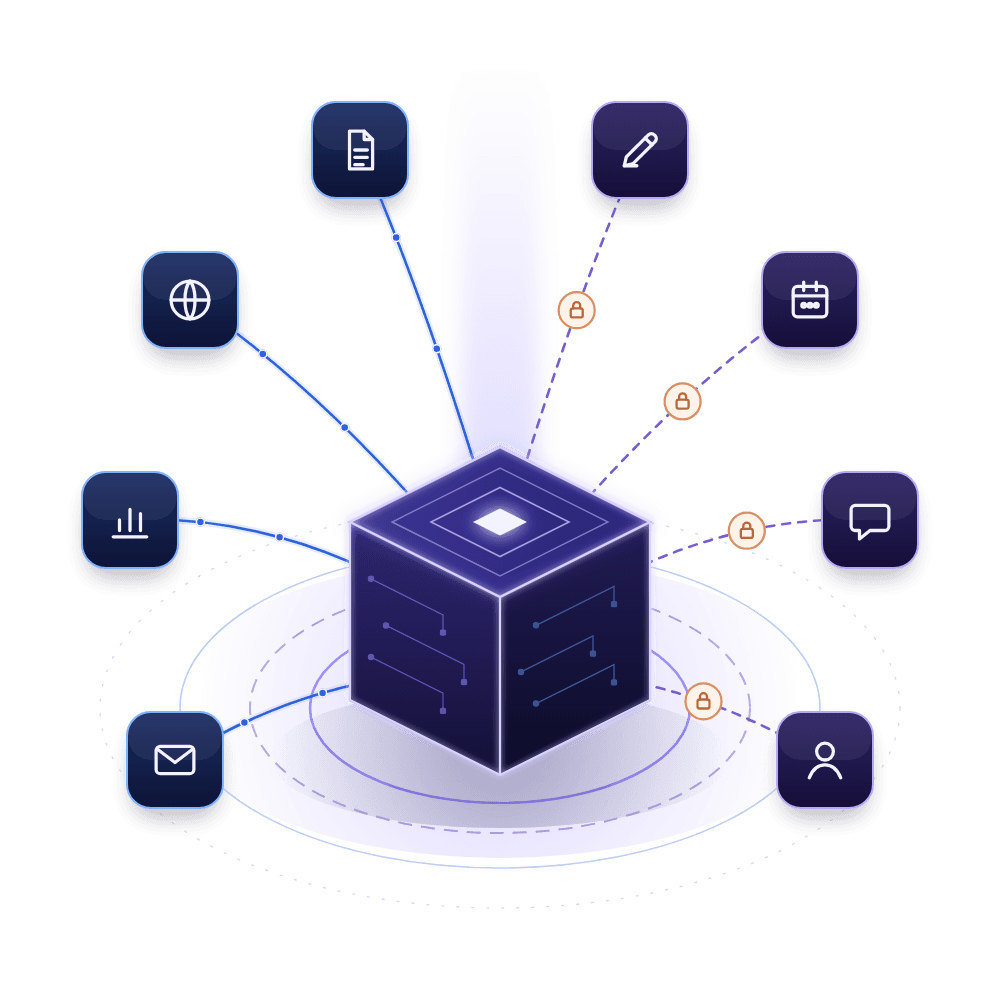
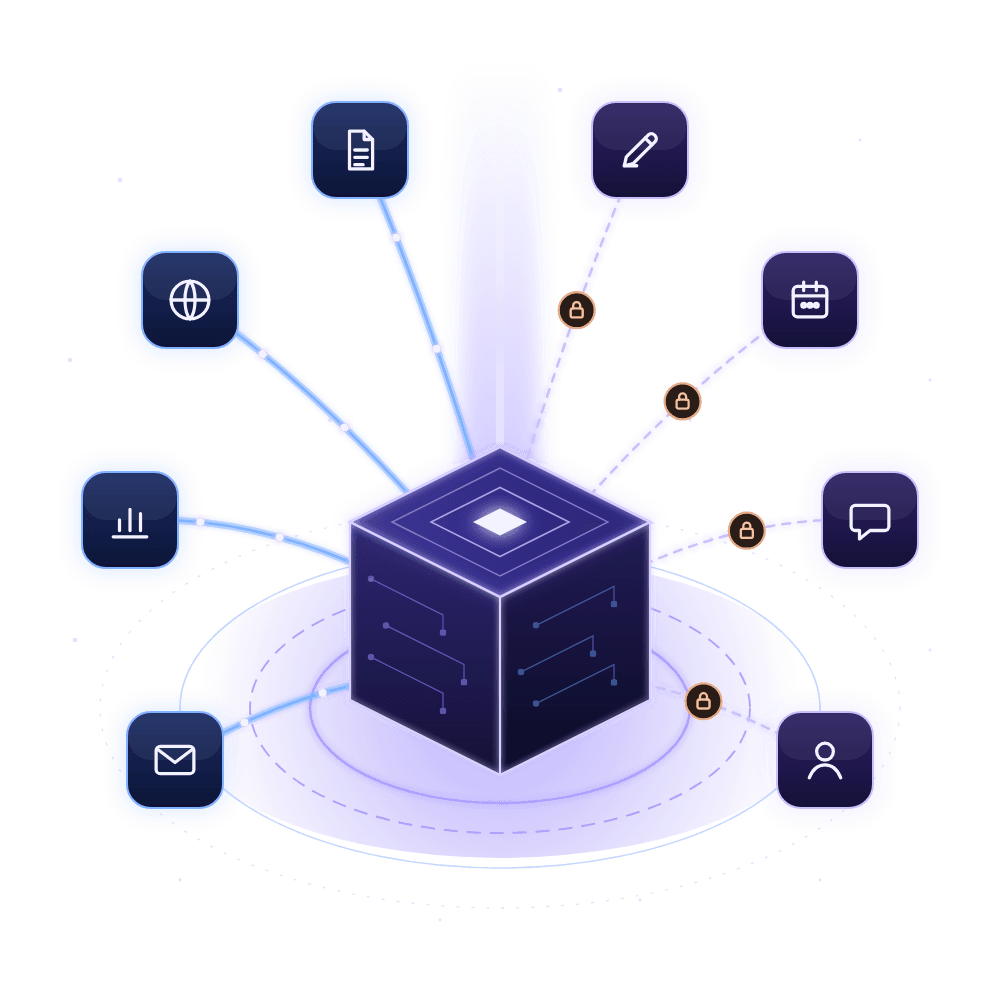
Agent · session key
Step 1: The agent asks
Alice asks her agent for the Morpho meeting brief. The agent queries Badge with a session key delegated by her Ledger: it grants the right to ask, never the right to decide.
Confidential memory for your agents
Badge is a company memory for AI agents, and it turns each employee's Ledger into their company badge. Your agent gets the context it needs. If that's a colleague's notes, the colleague approves first, on their Ledger.
You sign your consent on your Ledger.
For AI-native companies
Context is the most valuable asset of the AI era: the right context for the right task saves tokens and gets the job done. There is the company context: the business, its clients, its news, open to everyone. And each employee's personal context: notes, meetings, conversations. That is what makes an agent truly useful, and it is exactly what you can't hand to a server that sees everything.
How it works
The real flow of the demo: Alice is preparing a client meeting, and her agent needs Bob's notes.
Badge
Coinbase · Bob Durand
Ready
1 / 4 · The agent asks
Alice asks her agent for the Morpho meeting brief. The agent queries Badge with a session key delegated by her Ledger: it grants the right to ask, never the right to decide.
Inside the enclave, Badge's memory already knows everyone's context. It pulls the company context and Alice's notes, then spots three useful excerpts in Bob's notes. Deterministic rules screen out personal data and any bulk extraction.
His device shows what he is granting: to whom, the start of the excerpt and its length, for which task, until when, the text's fingerprint and the enclave measurement. Hold to sign: done.
The enclave checks the signature, expiry, nonce and fingerprint, then writes the brief with that single excerpt, provenance attached. The rest of Bob's context never leaves the enclave.
A prompt injection demands all of Bob's context. The enclave rules raise the alarm and Bob rejects it on his Ledger: nothing leaves, and compliance sees it.
"My Sales team can use my client notes for client briefs, for 30 days." Every use lands in the hash-chained log, and one signed revocation stops it all.
A Semaphore proof shows that a desk member approved, without revealing which one. Only compliance can reveal the identity, on its own Ledger, and that leaves a trace.
Trust architecture
Badge's memory lives in the cloud and knows everyone's context, so it doesn't ask for trust: it proves it. The code that handles context is measured and attested by Intel, and that measurement appears on every Ledger at signing time.
Read the README (opens in a new tab)Memory, policy and log live in a confidential virtual machine. The host only sees encrypted memory; logs and system info are never public.
Before any exchange, the client checks the Intel quote, the TCB, the compose hash, the app id and the image measurements. That measurement is also signed into every Ledger message.
The only route to the outside is a gateway pinned in the attested configuration, and it only reaches the confidential LLM. The deployer can't redirect it.
Only the excerpts a task needs go to Phala's confidential AI service, the only address the enclave can reach.
Five Coinbase employees share one enclave, each with an emulated Ledger Flex (Speculos). You play three of them: pick a role and follow the flow end to end.

Alice Martin
Sales
Asks her agent for a brief
Bob Durand
Key Accounts
Approves or rejects on his Ledger

Chloé Bernard
Legal & Compliance
Reviews the log and alerts
What your security and compliance teams will want to know first.
Read the code (opens in a new tab)Sharing everything leaks what should never leak, and rigid guardrails stop autonomous agents at every turn. Badge's memory knows all the context, injects only what a task needs (fewer tokens, better results) and asks the owner when it is personal.
In the enclave: an Intel TDX confidential virtual machine on Phala that holds the memory, the policy and the log. The web server and the agent only get what the enclave hands them: a brief, with the provenance of every excerpt.
Only the excerpts a task needs, once authorized, sent through the single gateway to Phala Confidential AI. A colleague's full context is never sent to the model.
Because the agent, the browser and the server cannot change what its screen shows. With clear signing (EIP-712), what the owner reads is exactly what they sign, and the enclave verifies that signature before releasing anything.
No: standing agreements cover recurring uses (one team, one purpose, one duration, a maximum size per excerpt). They are signed once, revocable, and every use is logged.
The revocation is signed on the Ledger and enforced by the enclave: every later use is rejected. What an agent already received can't be taken back, which is why consent is given excerpt by excerpt.
Every client verifies the Intel attestation before any exchange: TCB, compose hash, app id and image measurements. That measurement also appears in every message the Ledger displays and signs.
A desk shares with a Semaphore proof: it shows that an enrolled member approved, without saying which one, once the desk has at least three members. Compliance can reveal the identity with its own Ledger, and that reveal is logged.
Yes. Badge plugs into each employee's harness through a local MCP server with four tools: ask for the context of a task, follow the task, list the requests received, and check the enclave attestation. The agent can request a task and follow it, but never approve in the human's place.